Modern wire-guided missiles like the TOW and MILAN are limited to direct fire. Since they cannot penetrate the frontal armor of main battle tanks gunners must hope for a flank shot. There is also a chance that guidance wires become entangled in trees or break during flight, especially when tracking a moving target. Another problem is that the gunner must remain exposed to enemy fire while guiding the slow missile for up to 20 seconds through a cluttered battlefield. Finally, the missile launch creates a large backblast that attracts enemy fire and warns tanks to maneuver into cover.
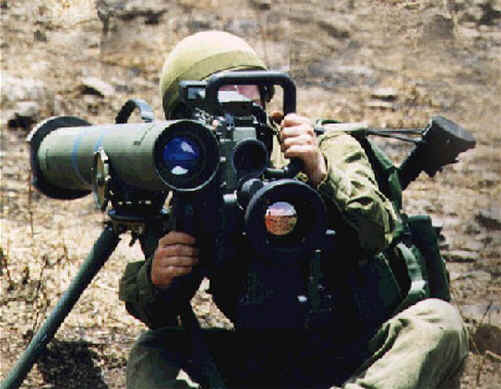 These limitations
are avoided with a VIdeo-GUided Missile (VIGUM) like the Israeli Spike (pictured) that can be fired indirectly like the larger EFOGM
system.
The idea is to fire the missile skyward and use a video link to crash the missile into a target.
The technology for VIGUMs allows them to dominate the modern battlefield from
40-8000 meters
away. The gunner can literally crash the missile into any target below.
This allows him to hit targets in the next city block or hit a window in a tall
building. The guidance wires cannot become entangled and enemy vehicles cannot hide in defilade.
These limitations
are avoided with a VIdeo-GUided Missile (VIGUM) like the Israeli Spike (pictured) that can be fired indirectly like the larger EFOGM
system.
The idea is to fire the missile skyward and use a video link to crash the missile into a target.
The technology for VIGUMs allows them to dominate the modern battlefield from
40-8000 meters
away. The gunner can literally crash the missile into any target below.
This allows him to hit targets in the next city block or hit a window in a tall
building. The guidance wires cannot become entangled and enemy vehicles cannot hide in defilade.
The falling missile has a large target picture from above and strikes a tank's thin overhead armor. Infantrymen can also use VIGUMs against crew-served weapons. In urban operations, VIGUMs can fly over or around buildings to strike any target with pinpoint accuracy. Spike VIGUMs have been sold to many nations, but the USA and the UK prefer the IR guided Predator. That is a great missile, but requires a heat source and may be confused by countermeasures.
Civilian electronics stores sell tiny inexpensive wireless security cameras that provide a color image. Martin Electronics developed a 40mm grenade round with a tiny camera and transmitter called HUNTIR (pdf). This allows quick reconnaissance using a tiny Chinese CMOS camera that also provides infrared images and costs less than $80 retail. It should not be difficult to use that technology with a wireless guided missile system. The gunner can use a cheap notebook computer and a joy stick to guide the missile like a video game. Video-guided mortar rounds are also possible. Wireless is great, but the signal is subject to interference and jamming.
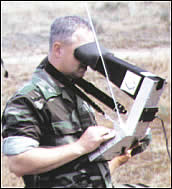 A helmet-mounted computer video display can provide the gunner with a better image.
The joystick can be replaced by a handheld "trackball" mouse. Accuracy may be improved by adding retarding
petals that pop-out when the missile motor shuts down over the target, like those now used to slow the speed of aircraft bombs.
This slows its descent and allows the gunner a few more seconds to view the battlefield and select a target.
Finally, low-cost simulators can provide gunners with unlimited realistic training.
A helmet-mounted computer video display can provide the gunner with a better image.
The joystick can be replaced by a handheld "trackball" mouse. Accuracy may be improved by adding retarding
petals that pop-out when the missile motor shuts down over the target, like those now used to slow the speed of aircraft bombs.
This slows its descent and allows the gunner a few more seconds to view the battlefield and select a target.
Finally, low-cost simulators can provide gunners with unlimited realistic training.
 VIGUMs are not a complex futuristic weapon.
They only require low-cost commercially available video technology to allow a human gunner to conduct
kamikaze missile attacks. Gunners learn from each attack, allowing them to recognize decoys, overcome countermeasures, determine if another attack is warranted, and provide instant intelligence to local commanders.
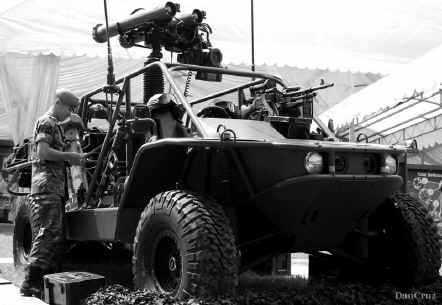
Singapore sells a Spike system mounted atop a light strike
vehicle. (pictured) These are the tank destroyers of the modern era, yet far
more effective than the World War II guns since they have far more range and can
kill indirectly.
VIGUMs are not a complex futuristic weapon.
They only require low-cost commercially available video technology to allow a human gunner to conduct
kamikaze missile attacks. Gunners learn from each attack, allowing them to recognize decoys, overcome countermeasures, determine if another attack is warranted, and provide instant intelligence to local commanders.
Singapore sells a Spike system mounted atop a light strike
vehicle. (pictured) These are the tank destroyers of the modern era, yet far
more effective than the World War II guns since they have far more range and can
kill indirectly.
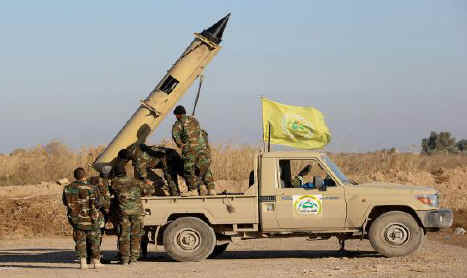 VIGUMs
can also provide precision artillery support from low cost platforms. A basic
pick-up truck can carry a 2000 lbs missile with a high explosive warhead as this
simple Iranian Mindex system demonstrates (pictured). The large missile
means it can use simple guidance like TOW wire spooling out or a wireless system.
Drones always uses wireless control, but for unknown reasons missile systems do
not. This "artillery system" requires a crew of one. The truck follows
forward forces and when they make contact, he stops, elevates and fires the
ballistic missile at the general target area and then guides it to a precision
hit via a video link. The accuracy and effect would be that of an airstrike,
with no risk to an aircraft and at less than 1% the cost. VIGUMs are a revolution that armies have failed to
acknowledge.
VIGUMs
can also provide precision artillery support from low cost platforms. A basic
pick-up truck can carry a 2000 lbs missile with a high explosive warhead as this
simple Iranian Mindex system demonstrates (pictured). The large missile
means it can use simple guidance like TOW wire spooling out or a wireless system.
Drones always uses wireless control, but for unknown reasons missile systems do
not. This "artillery system" requires a crew of one. The truck follows
forward forces and when they make contact, he stops, elevates and fires the
ballistic missile at the general target area and then guides it to a precision
hit via a video link. The accuracy and effect would be that of an airstrike,
with no risk to an aircraft and at less than 1% the cost. VIGUMs are a revolution that armies have failed to
acknowledge.
©2015 www.G2mil.com